Constellation Software ($CSU): Q2 2026 Earnings
$CSU Q2 2026 earnings show an accelerating pace of acquisitions, with the company capitalizing on depressed SaaS valuations (the SaaSpocalypse)

Welcome to Margin Valley Research! We research quality businesses trading at attractive prices due to external factors, not fundamentals deterioration, and therefore offer entry opportunities for long-term capital compounding, along with the macroeconomic conjuncture that drives the markets.
MVR is still completely free, if you’d like to support our work please consider subscribing, leaving a like, and restacking. Every contribution helps us deliver high-quality, actionable research for you to take informed decisions that drive consistent market-beating returns for your portfolio.
Q2 2026 Thesis Update
Constellation Software reported Q2 2026 earnings on August 11, 2026.
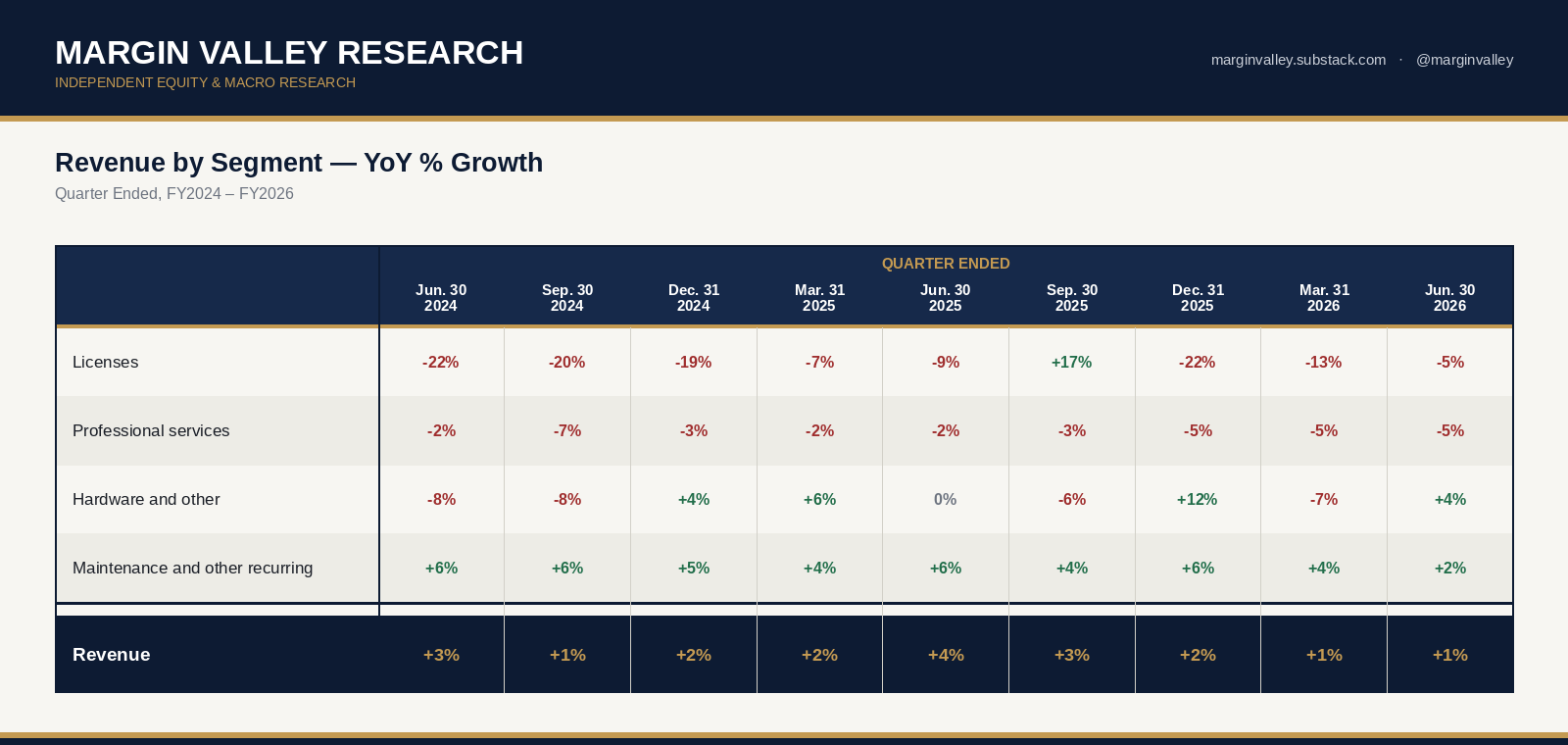
Revenues grew 17% YoY, but organic growth stayed at 1% when adjusted for the change in the valuation of the U.S. dollar against other currencies CSU operates in. Maintenance and other recurring revenues measures the performance of the underlying software businesses, this segment grew 4% in the last quarter but only 2% when adjusted for the impact of foreign exchange movements. An acceleration of recurring revenue would have been great to see, as it calms down fears of AI disruption. 2% is inside the average of the growth seen since 2024.
Reported EPS of $12.93 vs $2.66, up 386% YoY since Q2 2025, along with Net Income $274M vs $56M, was an earnings expansion driven by factors that extrinsic to the core business:
Positive Foreign Exchange Tailwind: $14M gain vs. $118M loss last year, a +$132M swing
IRGA/TSS revaluation: $64M charge vs. $126M charge
Effective tax rate: 27% vs. 53% in Q2 2025
Together, these account for roughly $190M of non-operating tailwind, not due to any operational results improvement.
These are the clear metrics that express this quarter’s performance:
Cash from Operating Activities: +10%
Free Cash Flow available to shareholders: +57%, benefiting from $80M of interest and dividends received vs $20M last year. The $69M Asseco dividend is included here, which is a non-recurring event. Underlying cash generation is closer to CFO’s, ~10%.
In April, we published our deep dive on Constellation Software. One of the medium-term growth opportunities we identified for the company is taking advantage of the “SaaSpocalypse” lower valuations to press the accelerator on acquisitions. At current multiples, these acquisitions can generate strong returns simple due to a private and public market re-rating. The numbers on H1 2026 confirm that CSU is taking this opportunity. During the first half of the year, acquisition spend was $1.59B, 2.6x the spend of H1 2025 ($604M). That takes announced H1 + subsequent deployment to ~2.4B, a materially faster pace than CSU’s historical run-rate.
Two individually disclosed deals:
Synchronoss ($309M, Feb 2026) — communications/media software, contributed $64M revenue and a $4M net loss H1
DerbySoft ($392M total, June 2026) — travel vertical, $11M revenue, $1M loss
Both were dilutive to operating margins, which is normal for CSU’s acquisitions, the ROIC comes from post-close operational improvements.
Disclaimer: Margin Valley Research is an independent research publication focused on macro analysis and equity research. All content published on this Substack is for informational and educational purposes only and does not constitute financial advice, investment advice, or a recommendation to buy or sell any security or financial instrument.
The views expressed are solely those of Margin Valley Research and are based on sources believed to be reliable, but no representation or warranty, express or implied, is made as to their accuracy or completeness. Past performance is not indicative of future results. All investments involve risk, including the possible loss of principal.
Nothing published here should be construed as the provision of personalised investment advice. Readers should conduct their own due diligence and consult with a qualified financial adviser before making any investment decision.
Margin Valley Research may hold positions in securities or instruments discussed in its publications. Any such positions will not be disclosed on an individual post basis and should not be interpreted as a conflict of interest.
This publication is not regulated by any financial authority. By reading this content, you acknowledge that you do so entirely at your own risk.