Weekly Macro Framework
Macro Framework — Week of 20–24 July 2026

Last week in review
The US disinflation print surprised to the downside, but equities did not celebrate. June CPI, released 14 July, cooled to 3.5% YoY from 4.2% in May, with core at 2.6% (from 2.9%) and headline monthly at –0.4% on energy. The reading effectively closed the door on a July Fed hike, though markets still hold some probability of a September move. Even so, US equities finished the week lower with tech leading, $SPX down roughly 1.6% and $NDX down closer to 4.1%.
The PPI confirmed the headline relief and the underlying stickiness in the same print. Headline PPI decelerated to +5.5% YoY (from +6.0%) with –0.3% MoM, mostly on energy. Core PPI moved the other way, accelerating to +4.7% YoY (from +4.6%) with +0.2% MoM. The dual message is coherent with CPI: the energy shock is easing at the surface, upstream pressures are not. That combination keeps central banks cautious and keeps the September conversation alive.
The Strait of Hormuz dominated geopolitical risk. The US-Iran situation escalated abruptly with the reinstatement of a naval blockade and a 20% transit levy on eligible cargo. Maritime traffic through the Strait fell to multi-week lows and Brent pushed toward $85–86 during the week, a peak weekly move near +11%.
US retail sales for June came in soft at +0.2% MoM against a revised +1.0% prior, consistent with a consumer that is turning cautious as certain supports fade.
The Bank of Canada held its policy rate at 2.25% on 15 July, in line with expectations, with domestic inflation repricing higher (3.2% YoY in May).
A note on our own read: last week we flagged a probable move lower in inflation with a hawkish reacceleration risk we never discounted. The actual CPI came in softer than we expected. Core PPI confirmed the underlying pressures have not disappeared. Recording it plainly: the short-term pendulum swung to disinflation, the September question remains open.
The week ahead
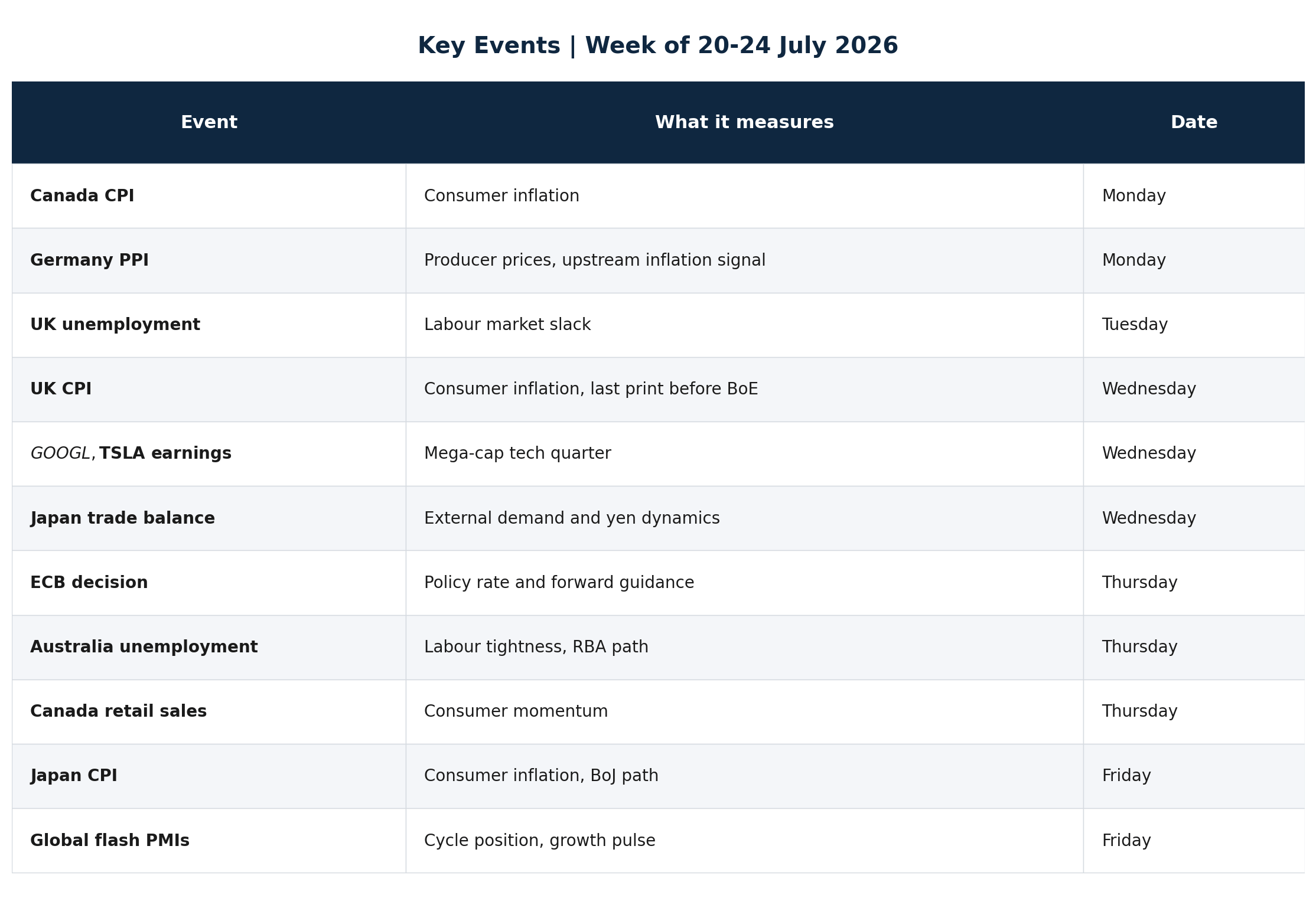
The 20–24 July window is catalyzed on two axes. First, the ECB decision on Thursday 23 July, the only G4 central bank meeting on the calendar. Second, the opening of mega-cap tech earnings, with $GOOGL and $TSLA reporting Wednesday after the close.
On the macro side, the calendar features UK CPI (Wednesday), Japan trade balance (Wednesday), Australia unemployment (Thursday), Canada retail sales (Thursday), and global flash PMIs (Friday).
Regional read
United States
No top-tier US macro data and no Fed communication of consequence. The week’s US signal comes from earnings. Wednesday concentrates the mega-cap block: $GOOGL and $TSLA after the close, alongside $IBM, $TXN, $NOW, and $KMI. The rest of the week includes $T, $VZ, $GM, $LMT, and $AXP.
After a benign June CPI, the market is looking for confirmation that margins and forward guidance justify current multiples. The Nasdaq correction into the print raises the bar. Combined with soft retail sales, the consumer resilience question stays live in every discretionary and consumer-cyclical report.
Europe and the UK
In the eurozone, the ECB decision is the whole story. The macro calendar around it is thin: the German ZEW (Tuesday) and eurozone consumer confidence (Thursday) give sentiment reads. The bloc’s inflation sits at 2.8% headline and 2.4% core, with quarterly GDP flat at 0.0%. The Hormuz-driven energy risk complicates the trajectory precisely when the ECB is asked to signal what comes next.
In the UK, June CPI on Wednesday is the week’s marquee release and the last inflation print before the Bank of England on 30 July. Consensus sits at 2.8–3.0%, and services inflation is the component under closest watch. A hotter print complicates the path to cuts. On the same day the UK also releases PPI, and Tuesday brings May unemployment and average earnings.
Britain is running the closest thing to an incipient stagflation dilemma in the developed world. Upstream, PPI has softened gradually with the YoY rate at +4.0% (from +4.1%) but +0.5% MoM, so relief exists but is slow. On the real side, the labour market has begun to soften with unemployment easing to 4.9% (from 5.0%), still elevated by recent standards but limiting the space for further tightening. That fragile balance between rigid services inflation and a cooling labour market keeps Bank Rate at 3.75% and makes Wednesday’s CPI a binary read for gilts and sterling.
Japan and China
Japan. The June trade balance on Wednesday is the only meaningful release, in a context where the Bank of Japan lifted its policy rate to 1.0% in June and meets again 30–31 July. Domestic inflation is at 1.5% YoY (1.4% core), above target but contained. The yen remains structurally pressured by the rate differential against the dollar, which is what keeps the BoJ on its normalization path.
The critical variable is still the yen. With USD/JPY around 162, the currency is historically weak, raising the risk of verbal intervention and reinforcing the BoJ’s incentive to move. The structural climb in Japanese yields, with the 10-year JGB near 2.71%, has implications beyond Japan. As domestic debt becomes more attractive, Japanese investors, among the world’s largest holders of foreign bonds, have less reason to reach abroad for yield. That is a latent pressure point for global fixed income.
China. No major calendar events. The backdrop remains low inflation and decelerating growth: CPI at 1.0% YoY, Q2 GDP cooling to 4.3% YoY, retail sales recovering to +1.0% YoY but with the domestic pulse still fragile and stimulus-dependent. The renminbi remains administered, with the PBoC reference rate at 3.0%.
Politics and geopolitics
The Strait of Hormuz remains the dominant risk vector. Last week’s escalation left the naval blockade in place, reciprocal strikes recorded, and the 20% transit levy in force on eligible cargo. Maritime traffic fell to multi-week lows. At publication, oil has pulled back from the peaks and the VIX has drifted lower, suggesting partial tactical de-escalation without formal resolution.
This is the primary tail risk for energy and for global risk sentiment. The asymmetry is clean: escalation would be immediate and violent, normalization gradual and priced in slowly. Our working assumption stays that a prolonged impasse reintroduces the geopolitical risk premium, with crude jumping into the $80s, gold pressing highs, and global equities in risk-off.
Key events this week
Bonds, yields, and rates
US Treasuries. The 10-year Treasury reflected the benign CPI with the yield now around 4.54% versus 4.57% the prior week. This is a moderate move, not a regime change. The market took the July hike off the table but left September on. The long end stays anchored at elevated levels.
Bunds. The German 10-year around 3.14% is stable and waiting for Lagarde. A communication that validates a September hike would pressure Bunds higher in yield.
Gilts. The UK 10-year around 4.97% is the most vulnerable sovereign in the developed universe, penalized by the deficit-inflation combination and highly sensitive to Wednesday’s CPI. An upside print would push the yield above 5% easily.
JGBs. The Japanese 10-year around 2.71% continues its structural climb tied to BoJ normalization and accelerating domestic PPI, with potential repercussions for global debt flows.
Our read is that the axis of rate action shifts from America to Europe this week. The ECB (Thursday) and UK CPI (Wednesday) pairing concentrates the movement potential. Gilts carry the highest beta to any inflation surprise. Bunds are hostage to Lagarde’s tone.
Central banks and earnings
One G4 central bank meets this week (ECB, 23 July), alongside the PBoC which met Monday 20 July. The others are in communication mode. Current standings:
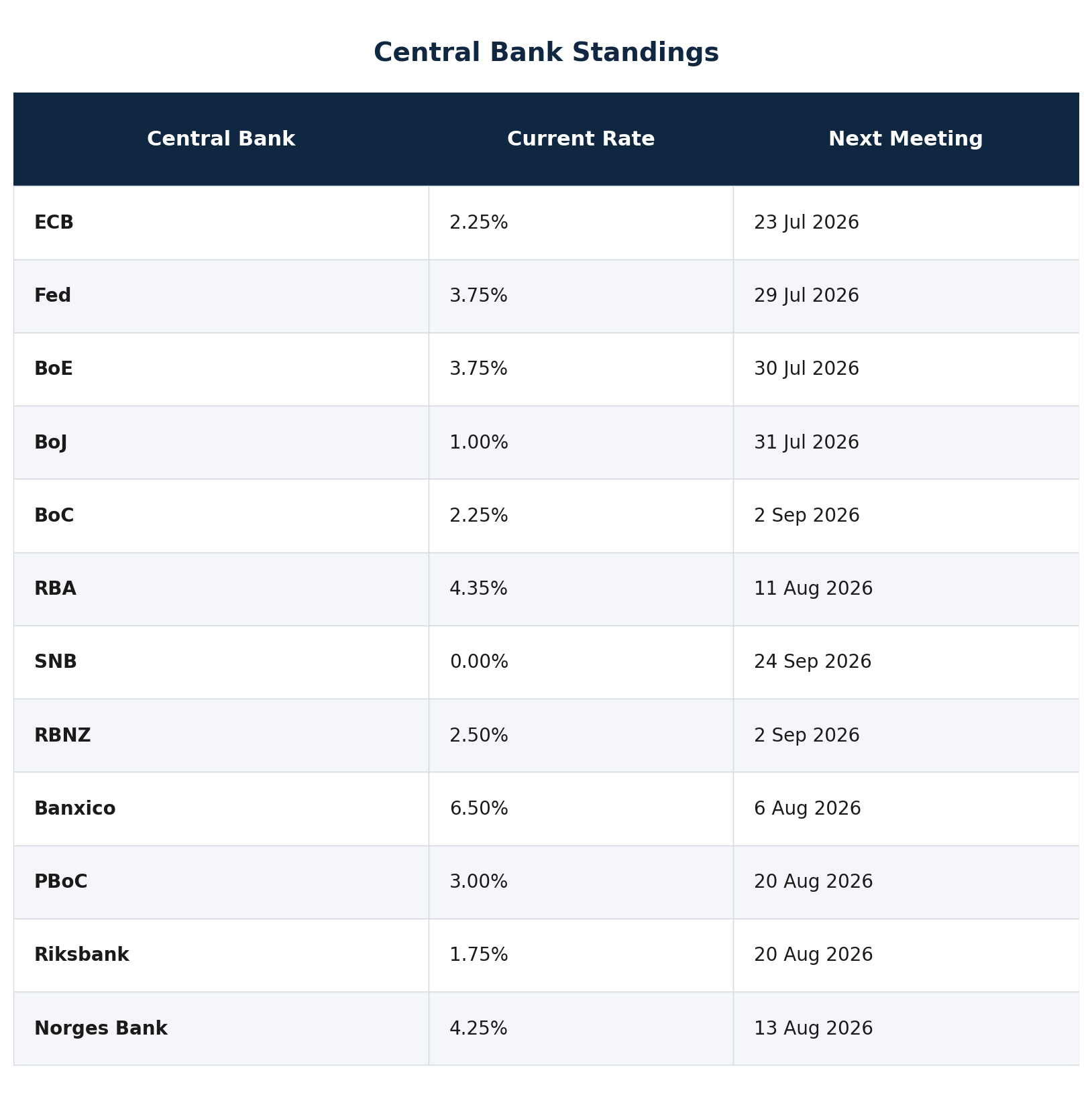
PBoC. Held at 3.00% / 3.50%, as expected.
ECB. Consensus is for a hold at 2.25% on the deposit rate, with no new macro projections. Given the outcome is close to consensus, the entire signal sits in Lagarde’s press conference. The underlying debate is whether the resilience of energy prices, amplified by the Hormuz shock, warrants a return to tightening, and whether a September move to 2.50% becomes part of the ECB’s base case, and by extension the market’s.
Our view is that the risk skews hawkish. Any validation of a September step, even lightly hinted, would pressure Bunds and support the euro. A deliberately ambiguous tone would read as relatively dovish.
Earnings. Three of the seven mega-caps report Wednesday: $GOOGL (both share classes) and $TSLA. The read-through matters especially at a moment when the market is questioning whether AI capex is translating into cash generation on the timeline that has been priced in.
FX
A week defined by the ECB.
USD
The dollar enters without a top-tier domestic catalyst. The Fed and first-line data come only next week. It trades reactively to geopolitics, ECB communication, and UK CPI. The benign CPI last week removed some rate-based support, though the safe-haven status remains latent while Hormuz is unresolved.
Our read: probable range trade with a slightly defensive lean in calm conditions, with fast appreciation potential if geopolitics reactivates safety demand. The structural argument for dollar strength has not gone away. The Middle East tension has not dissipated, only softened. In periods of elevated geopolitical volatility, USD-denominated assets attract flow, and that mechanical support keeps pressure on global currency pairs.
EUR
The euro is the pair most dependent on a single event this week: Lagarde’s Thursday communication. The hold is already priced. The move comes from the September signal. A validation of the hike scenario supports the euro through the differential channel. An ambiguous tone weighs on it.
The structural backdrop, growth stagnating in the bloc, caps the potential for sustained appreciation.
Our read: high binary sensitivity into Thursday, with a supportive lean if Lagarde confirms the hawkish inclination. In the shorter horizon, we still hold a constructive tactical stance for the euro against the dollar, though limited by weak eurozone growth. The base scenario stays lateral-with-upward-bias, with gradual advances and technical corrections consistent with repositioning opportunities.
JPY
USD/JPY around 162.5 keeps the yen historically weak despite BoJ normalization and domestic PPI accelerating to +7.1%. The rate differential remains the dominant driver, but levels above 162 raise the risk of verbal intervention from Japanese authorities and introduce asymmetry in favor of short-term yen appreciation. In a risk-off shock, the safe-haven status offers additional support.
Our read: probable persistent weakness driven by carry, with rising risk of a sharp correction via intervention or accelerated BoJ normalization. The structural bias, assuming controlled US CPI, still points to gradual yen appreciation as the BoJ advances rate hikes and Japanese investors repatriate capital. Being alert to intervention is prudent. So is understanding that until convergence begins, the yen’s depreciation remains structural.
GBP
Sterling has its central domestic catalyst this week in the UK CPI on Wednesday. Supported by elevated Gilt yields and a cautious BoE, the pound preserves the carry but coexists with fiscal fragility and weak growth.
An upside CPI print, especially in services, would support the currency immediately by pushing cut expectations further out. A softer print reopens the path for the BoE on 30 July and pressures sterling.
Our read: reactive to CPI, with sharp movement potential in either direction given the binary nature of the read. We lean toward a softer print without abandoning the base case of vulnerable lateralization exposed to fiscal deterioration or a risk shock. Our tactical stance is unchanged: a mildly positive lean for sterling against its peers, supported by the inflation-control sentiment as domestic recovery is worked through.
Antipodeans
AUD. The Australian dollar has its test in Thursday’s unemployment print. The RBA holds at 4.35%. Structural sensitivity to Chinese demand for commodities means a softer print can weigh.
NZD. The kiwi benefits from relative support after the RBNZ raised its policy rate to 2.50% on 8 July, its first hike in over three years. Both are cycle currencies tracking global risk appetite and the Chinese pulse. Our take: the NZD holds a carry advantage over the AUD given the RBNZ’s hawkish tilt, with an appreciation bias sustained by carry, moderated only by potential risk-off shocks tied to China or oil.
CAD
The Canadian dollar remains vulnerable to geopolitical dynamics. Recent signs of diplomatic re-engagement, by correlation, feed depreciation pressure on a currency strongly tied to oil.
Commodities
Oil
WTI was trading near $79.83 at publication, a pullback from the prior week’s peaks when the Hormuz escalation pushed Brent to a weekly move near +11%. The partial correction does not eliminate the geopolitical risk premium. It reflects that tactical de-escalation over recent sessions has returned some perceived supply.
The market structure remains dominated by the Hormuz-Iran binomial, the most asymmetric directional factor across the entire commodity complex. On the supply side, maritime traffic through the Strait fell to multi-week lows and the 20% transit levy functions as an added cost that transmits to the price. On the demand side, Chinese deceleration and softening US consumption exert opposite pressure, capping any sustained rally under a normalization scenario. The result is a tense market oscillating on geopolitical headlines more than on fundamentals and inventories.
Our read: risk asymmetry is now two-sided. To the upside on the short horizon, an effective disruption of Strait flow would easily reopen the higher band and revive global inflation concerns, feeding into the energy component of CPI baskets. To the downside, a diplomatic resumption would drag prices back, more slowly, toward the recent early-July lows.
The paradox is unchanged: continued military escalation coexists with an oil market that trades symmetrically between drops and recoveries. That positioning creates a pronounced asymmetric risk. If sanctions on Iran ease additionally, or if Hormuz effectively closes again, the repricing of the geopolitical premium would be immediate and sharp.
Precious metals
Gold traded near $4,013 (+0.35%) and silver near $57.05 (+2.42%), with silver outperforming clearly on relative strength. The macro backdrop is structurally favorable to precious metals: real yields more contained after the benign CPI reduce the opportunity cost of holding non-yielding assets, a dollar without a clear trend offers no resistance, and the Hormuz risk premium sustains hedging demand.
Our read on gold is that it is consolidating its role as store of value and portfolio hedge in a regime of dual uncertainty, inflationary and geopolitical. The anchoring near $4,000 reflects structural demand from central banks and institutional investors who, in an environment of elevated sovereign debt and geopolitical friction, prefer assets outside the credit system. While real yields remain contained and Hormuz risk stays latent, the bias remains constructive, with corrections read as repositioning opportunities rather than trend reversals.
Silver adds a cyclical dimension to the metals thesis. Its dual nature as precious metal and industrial input (electronics, solar panels, etc.) makes it more sensitive to the global economic cycle and explains the greater amplitude of movement against gold, both on the way up and on the way down. Silver’s relative outperformance this week suggests the market is incorporating not only the monetary-hedge theme but also expectations of resilient industrial demand.
Our take on silver: it offers higher beta to the metals thesis, amplifies gold in a reflationary scenario, and punishes more sharply on industrial cycle deterioration, particularly if China surprises negatively.
Base scenario (unchanged)
Despite recent geopolitical developments, our view stays cautious and analytical, with a broader lens confirming that the base scenario remains intact even as political and geopolitical dynamics have shifted and energy prices have risen, which for now are not showing up in asset prices with the exception of oil.
The base case remains slow but steady growth, inflation still sticky and increasingly uncertain (which likely brings volatility on data release dates), and a still-resilient jobs market inside a supposed gradual Fed cutting cycle that now looks more distant, one that market expectations could re-ignite around new fiscal and trade policy.
The perpetual buyers, corporate buyback programs, enter blackout at the start of the month, removing one flow that has consistently supported some risk assets.
The relationship between growth, employment, inflation, and monetary policy points to an environment less favorable to duration assets than the prior week. Short yields have stopped compressing and are now pressured higher on the hawkish repricing. Long yields stay tensioned by supply, term premium, and the oil-driven inflation shock. The curve faces bear-flattening risk if CPI surprises.
Prevailing sentiment stays cautious into the week, with asymmetry still negative for risk assets despite recent all-time highs on some equity indices. On average, the market remains relatively neutral in directional positioning, sitting in a moderate correction-risk environment where many investors remain wary of how prices will react to new geopolitical headlines. In a context where the news flow is often fragmented or contradictory, surprises tend to generate amplified moves, reinforcing a more contained trading posture and heavier emphasis on risk management.
Closing thoughts
Last week we wrote that in markets that change direction quickly, the risk is not in getting the direction wrong. The risk is holding the old direction out of stubbornness. Emotional intelligence for investors is measured by how quickly one recognizes the map has stopped matching the territory.
Last week was a humility lesson for anyone attached to a narrative. Many entered convinced inflation would reaccelerate and punish the market. The CPI came in soft, initially lifted markets as we anticipated, and equities fell anyway, dragging the indices with them. Markets do not pay for correct forecasts. They pay for correct analysis, strategy, and positioning against what is already priced.
When everyone already expects “something,” that “something” stops being fuel. This week, with the ECB and mega-caps in front of us, the temptation is again to anticipate the outcome and marry a thesis. Check your map.
The message for this week: avoid binary events and be alive to the sharp moves they generate. The base case points to a firm dollar bias, yields under upward pressure, and equities exposed to disappointment.